In this life where so often we are rationed out pat little packages of worldviews, it is helpful to broaden one's self and have occasion to reevaluate what one takes for granted. I feel that we grow closer to truth by having the truths we hold challenged, grow closer to the fellow inhabitants of this planet by trying on different worldviews, and, Borg-like, come away with useful bits gleaned. As Solomon wrote, "Do you see a man who is wise in his own eyes? There is more hope for a fool than for him."
Much like genetics and pathology, variety is not only life's very spice, but the glue that holds existence together and, I would even go so far as to suggest, one of the keys to a peaceful existence.
In college, I studied Cultural Anthropology with Professor Paul Apodaca and one of the points that has stuck with me all of these years later (along with my studies in Freud) is the concept of taboo in civilization. I distinctly remember Professor Apodaca saying that incest is one of the only nearly universal taboos in humankind, even within cultures where other widespread taboos (like cannibalism) exist. One could make a fairly succinct argument of the evolutionary functions for the emergence of that taboo. There are also the psychological effects of a secure family unit (and the psychological terrors of an insecure one) as well as the customary moral, social, and religious proscriptions on transgressing taboos to the extent that most healthy individuals never even consciously dream of breaking said taboos. This is a very good thing.
We have already established that the Greeks employed heightened emotional manipulation for the purpose of hooking the audience into the action of their dramatic works. I would add that this is at least the second play in this series in which the subject of incest comes up, likely because it is such an efficacious emotional manipulator.
I find that taboos can be helpful to a civilization, as can morals, ethics, and manners. Restraint in society shows a regard for others, that one sees the value of others and chooses to take that into account vis-à-vis their own behavior. Cultures establish taboos to preserve the culture. Taboos can be valuable and should be employed, I feel, when they promote the opportunity for life, liberty, and the pursuit of happiness (in that order) in all of the citizenship.
One of the "different set of eyes" which I have found fascinating in this series is the role of the gods in the lives of humans in the Greek worldview. They have a built in answer for the apparent absurdity of existence. In this piece, bad things happen to people because a goddess gets moody and feels slighted. In other words, the tragedy unfolds because of things people didn't do. Aphrodite is upset because Hippolytus goes hunting with Athena and is apparently asexual or, at least, pursuing interests outside of the boudoir. This bothers Aphrodite to the point where she decides to burn his family to the ground and salt the Earth where once they grew. Every time I've been in an automobile accident I've marveled a bit over how leaving my home a minute or two earlier or later would have averted the whole situation. It occurs to me that this view of the gods offers some ready-made solutions in moments like that.
Aphrodite, in her rage, strikes Phaedra, Hippolytus' step-mother, with a mad crush on Hippolytus. I was surprised to find that no one in the piece, faced with this information, says, "Well, knock that off! That's totally inappropriate, Phaedra!" Her nurse almost commits self-slaughter faced with the knowledge. But, for the most part, her crush is treated like cancer. It is unfortunate, but she can't just walk it off. I was mystified by that part of the play. I suppose it was an attempt to make Phaedra a sympathetic character, but I'm not entirely sure why she needed to be sympathetic or why Euripides thought that would work as a character choice. I mean, it's like saying "Yes, I murdered my wife, but it's not my fault because I was really really angry at the time." I had the same sort of difficulty (albeit much more strongly) when I tried to read Ayn Rand many years ago. Yes, I see what they are trying to get me to sympathize with, but I don't! I reject the premise because what they are talking about is evil, no matter how much they zazz it up with rhetoric - a major difference being that I never physically threw the book of Euripides across the room.
So, Phaedra hangs herself and things continue to deteriorate from there. Hippolytus gets chased down and dragged, thanks to a water buffalo. Theseus shoots his mouth off and, as a result, has to watch all of his loved ones die. Artemus is, at the end, waiting to get revenge on Aphrodite and we walk out of the theater having had the embodiment of romantic love presented as the ultimate antagonist, having heard a long anti-woman tirade, having witnessed a grandfather kill his grandson because he granted his son three curses (which I'm not sure I can imagine a place in which that would be an appropriate gift.) In my mind, this is the very model of a problem play.
I do have to say that it was an entertaining work and certainly thought provoking. Here I am days later still mulling over exactly what I was supposed to think and why. But I do think that there is profit in the exercise even if I come to different conclusions. It gives me opportunity to evaluate what I believe and why, and what I don't believe and why. Time engaged in that activity is never wasted time.
The next two pieces in this series is deal with my favorite Greek god, which is to say Dionysus. In the next piece, heads will roll. In the piece that follows, The Frogs, based solely on what I've experienced here, I think Dionysus is correct in choosing Aeschylus as the superior playwright to Euripides.
Sunday, January 22, 2012
Saturday, January 14, 2012
Antigone, by Sophocles
The shift from Aeschylus to Sophocles brings a variety of thematic differences. There are certainly different views of women and of gods (which is not to say that they were of different beliefs, rather that they were of different points of view. The God of Thomas Merton and the God of William F. Buckley look very different from one another, but both men were of the Roman Catholic church.)
This is the first Greek tragedy in our series in which the main character doesn't actually do anything wrong. The tragic "heroes" of Aeschylus are people who do wrong for possibly understandable reasons and suffer the consequences. Sophocles has Oedipus who makes a series of horrible mistakes, but for the most part they are simply tragic mistakes. But Antigone, in fact, suffers punishment for doing right. She buries her brother (twice actually) with no fear of consequences and is proud to admit it. I might even mention the political undertone of what is right superseding what is law in behavior befitting a virtuous citizen. Antigone herself is, I might argue, our first strong, good woman in our series of Greek tragedies. She is a person of great conviction and integrity.
Also, it passes the Bechdel Test.
As an aside, there was a play by Jean Anouilh written in Nazi occupied France that was a retelling of the Antigone story, seemingly with a Nazi-style government as Creon's reign, but written ambiguously enough to pass the censors. In college, I really wanted to mount a production of it, but, like so much of my theater stories, it never ended up happening. In it, Antigone gives this famous rousing speech to Creon:
The gods do not make an appearance in this piece, however I would like to point out an emerging trend that I am sensing. There is a sense of "sin" in Greek mythology. However, one of the key differences between sin to their gods and sin in Christianity is that their gods are not necessarily nice, fair, and certainly don't seem to have our best interests at heart. It reminds me a bit of Shintoism in that above all one ought to do everything in one's power not to offend the gods. There is an element of "sins of the father" in this play.
The sins of Creon seem to be two-fold. He punishes Antigone for deeds that ought not be punished and his other major sin, I contend, is that he fails to listen to the wisdom of Tiresias. It would seem likely to me that that would be a mortal sin in the Ancient Greek worldview. All of his sins get jumbled in the stew, but the price that Creon pays is devastating.
It is my belief that the price that Creon pays indicates the author's belief about who was right and who was wrong in the piece. It is also my belief that Antigone receives a really bleak sort of grey hint of a reward when her beloved and she are united in the Underworld. I have to confess, whenever I read a Greek play, I always imagine that Hades is like it's portrayed in Sondheim's version of The Frogs. This is probably grossly misguides my opinions. I sing Pluto's song from that play while I'm working all the time!
I would also confess that if I were Dionysus (and I am still waiting for my wife to paint a portrait of me as Dionysus) and I went to Hades to bring back the better playwright, I think I very well might bring Sophocles over Aeschylus. In spite of the fashion sketches that the latter inspired. Or maybe it's just that I find the world of Sophocles more compelling and accurate. Aeschylus had a rigid sense of right and wrong, crime and punishment. In Sophocles, people make horrible mistakes and good people suffer tremendously as well as the bad. That seems more like the nature of the universe I've come to understand.
This is the first Greek tragedy in our series in which the main character doesn't actually do anything wrong. The tragic "heroes" of Aeschylus are people who do wrong for possibly understandable reasons and suffer the consequences. Sophocles has Oedipus who makes a series of horrible mistakes, but for the most part they are simply tragic mistakes. But Antigone, in fact, suffers punishment for doing right. She buries her brother (twice actually) with no fear of consequences and is proud to admit it. I might even mention the political undertone of what is right superseding what is law in behavior befitting a virtuous citizen. Antigone herself is, I might argue, our first strong, good woman in our series of Greek tragedies. She is a person of great conviction and integrity.
Also, it passes the Bechdel Test.
As an aside, there was a play by Jean Anouilh written in Nazi occupied France that was a retelling of the Antigone story, seemingly with a Nazi-style government as Creon's reign, but written ambiguously enough to pass the censors. In college, I really wanted to mount a production of it, but, like so much of my theater stories, it never ended up happening. In it, Antigone gives this famous rousing speech to Creon:
"I am disgusted with your happiness! With your life that must go on, come what may. You could say you are all like dogs that lick everything they find. You with your promise of a humdrum happiness--provided a person doesn't ask much of life. I want everything of life, I do; and I want it total, complete: otherwise I reject it! I will not be moderate. I will not be satisfied with the bit of cake offered for being a good little girl. I want to be sure of everything this very day; sure that everything will be as beautiful as when I was a little girl. If not, I want to die!"It is an uncompromising vision, just as the Antigone of Sophocles. I confess that I admire both Antigones.
The gods do not make an appearance in this piece, however I would like to point out an emerging trend that I am sensing. There is a sense of "sin" in Greek mythology. However, one of the key differences between sin to their gods and sin in Christianity is that their gods are not necessarily nice, fair, and certainly don't seem to have our best interests at heart. It reminds me a bit of Shintoism in that above all one ought to do everything in one's power not to offend the gods. There is an element of "sins of the father" in this play.
The sins of Creon seem to be two-fold. He punishes Antigone for deeds that ought not be punished and his other major sin, I contend, is that he fails to listen to the wisdom of Tiresias. It would seem likely to me that that would be a mortal sin in the Ancient Greek worldview. All of his sins get jumbled in the stew, but the price that Creon pays is devastating.
It is my belief that the price that Creon pays indicates the author's belief about who was right and who was wrong in the piece. It is also my belief that Antigone receives a really bleak sort of grey hint of a reward when her beloved and she are united in the Underworld. I have to confess, whenever I read a Greek play, I always imagine that Hades is like it's portrayed in Sondheim's version of The Frogs. This is probably grossly misguides my opinions. I sing Pluto's song from that play while I'm working all the time!
I would also confess that if I were Dionysus (and I am still waiting for my wife to paint a portrait of me as Dionysus) and I went to Hades to bring back the better playwright, I think I very well might bring Sophocles over Aeschylus. In spite of the fashion sketches that the latter inspired. Or maybe it's just that I find the world of Sophocles more compelling and accurate. Aeschylus had a rigid sense of right and wrong, crime and punishment. In Sophocles, people make horrible mistakes and good people suffer tremendously as well as the bad. That seems more like the nature of the universe I've come to understand.
Tuesday, January 10, 2012
Ask Paul Mathers: Are Americans interested in Sir Thomas Browne?
You can ask Paul Mathers a question about arts/literature/culture/history/etiquette by sending it to: askpaulmathers@gmail.com
As mentioned, here's a link to my post on Religio Medici: http://ticklemebrahms.blogspot.com/2010/12/religio-medici-by-sir-thomas-browne.html
You can buy a paperback copy (the very same imprint as the one I own) of Religio Medici here: http://www.amazon.com/Religio-Medici-Hydriotaphia-Classic-Reprint/dp/1440061238/ref=sr_1_13?ie=UTF8&qid=1326266180&sr=8-13
And here you can download an eBook edition for cheap (although the misspelling of the author's name raises my eyebrow a bit): http://www.amazon.com/Religio-Medici-ebook/dp/B004IAS15O/ref=sr_1_2?s=digital-text&ie=UTF8&qid=1326266304&sr=1-2
You can buy a paperback copy (the very same imprint as the one I own) of Religio Medici here: http://www.amazon.com/Religio-Medici-Hydriotaphia-Classic-Reprint/dp/1440061238/ref=sr_1_13?ie=UTF8&qid=1326266180&sr=8-13
And here you can download an eBook edition for cheap (although the misspelling of the author's name raises my eyebrow a bit): http://www.amazon.com/Religio-Medici-ebook/dp/B004IAS15O/ref=sr_1_2?s=digital-text&ie=UTF8&qid=1326266304&sr=1-2
Monday, January 9, 2012
Prometheus Bound
On Sunday, Laurie and I were talking to our friend Tim about Louis XIV. I secretly admire Louis XIV's techniques for strengthening France and his socio-political prowess, but am careful not to say it too loudly or too often as history hasn't treated Louis favorably (I am hoping to not get ejected from Cannes.) Tim mentioned how Louis wanted everything to flow directly from his throne, to be the dispenser of everything, to demand dependence. Laurie mentioned that there was a temptation to do that as a parent (for example, not teach your children to cook so that they will keep needing you.) In spite of my conviction that information should flow freely, I can totally understand this temptation. I think it perfectly illustrates the sin of Prometheus.
One of the cardinal rules that we learned in my college play-writing courses was to "show and not tell." You can, of course, have the "Robert Shaw talking about the sharks" monologue at some point, so long as you show the audience plenty of actual shark carnage through the rest of the show. The Greek tragedians seem to have had no such rule. While there is spectacle, it is often not where we would have put it. They talk about the fall of the gods, about the chaining of Prometheus, about the storms that are to batter Prometheus on his rock, and we meet a character who, in her future history, is going to turn into a cow (extra credit opportunity: I knew the story of Io and was totally confused over whether or not she was a cow in this play. I kept switching back and forth in my head as I read like the Ghost of Christmas Past.) None of these are shown onstage, but a guy does come riding in on a four-footed bird. It reminded me that while I was reading The Oresteia I thought, "I know the script has the murders take place offstage, but in my production they would sure as heck be in full bloody view of the audience!"
A point of interest about the play is that it was traditionally attributed to Aeschylus, but modern scholarship now has grave and serious doubts over the authorship. There have been arguments over the author's meter and line structure. One of the more compelling arguments, in my opinion, is over the discrepancy in the view of Zeus in The Oresteia and the view of Zeus in Prometheus Bound. My personal opinion is that the arguments are compelling enough to have me refer to it as "the author of Prometheus Bound" rather than Aeschylus. In any discussion of doubt of the authenticity of authorship of a piece of literature, I feel it is best to attempt to see through the arguments to the motivations of those arguing. That is why, for example, I feel compelled to agree with the doubt on the Pauline authorship of the Epistle to the Hebrews (most of those who make the argument would have nothing but gain from an actual apostolic author) while I reject outright the questioning of Shakespeare's authorship (an argument that has always struck me as conspicuously classist.)
I chose Edith Hamilton's translation. I think Hamilton's work will fill in most of what Robert Fagles didn't get around to translating for me as I read through the Greeks. Like Fagles, I would read anything Edith Hamilton had anything to do with and likely would have followed her off a cliff if called upon to do so. Edith Hamilton was one of the awesome, underrated figures in academic history, artfully building bridges from the common reader to the sublime (I almost went with "putting the ambrosia on a lower shelf," but feared it would sound like a back-handed compliment.)
As for the play itself, in spite of what I said above about action and spectacle, I think it is a wildly successful piece. There is so much heightened emotion and the speeches are so evocative that I feel it would be a delight for any actor to perform. The mythology is rich and potent. We are left with a universe in which a sovereign god who hates us knows that his days are numbered. Like Herod, Zeus' insecurity over the prophecy is leading him to effect the most atrocious outcomes on innocents. Most of the goodness and, indeed, humanness that we enjoy in our existence was a gift from a god who is now being tortured for having given that gift. Prometheus is clearly put forth as the protagonist and I was especially moved by his defiance in the face of threats and torture. Aware of his own immortality, he does not care how much torture is doled out on him so long as he is being true and virtuous. This seems to be the moral of the story from a distant culture which was convinced of the immortality of the soul. This is what it means to live as though that were true.
One of the cardinal rules that we learned in my college play-writing courses was to "show and not tell." You can, of course, have the "Robert Shaw talking about the sharks" monologue at some point, so long as you show the audience plenty of actual shark carnage through the rest of the show. The Greek tragedians seem to have had no such rule. While there is spectacle, it is often not where we would have put it. They talk about the fall of the gods, about the chaining of Prometheus, about the storms that are to batter Prometheus on his rock, and we meet a character who, in her future history, is going to turn into a cow (extra credit opportunity: I knew the story of Io and was totally confused over whether or not she was a cow in this play. I kept switching back and forth in my head as I read like the Ghost of Christmas Past.) None of these are shown onstage, but a guy does come riding in on a four-footed bird. It reminded me that while I was reading The Oresteia I thought, "I know the script has the murders take place offstage, but in my production they would sure as heck be in full bloody view of the audience!"
A point of interest about the play is that it was traditionally attributed to Aeschylus, but modern scholarship now has grave and serious doubts over the authorship. There have been arguments over the author's meter and line structure. One of the more compelling arguments, in my opinion, is over the discrepancy in the view of Zeus in The Oresteia and the view of Zeus in Prometheus Bound. My personal opinion is that the arguments are compelling enough to have me refer to it as "the author of Prometheus Bound" rather than Aeschylus. In any discussion of doubt of the authenticity of authorship of a piece of literature, I feel it is best to attempt to see through the arguments to the motivations of those arguing. That is why, for example, I feel compelled to agree with the doubt on the Pauline authorship of the Epistle to the Hebrews (most of those who make the argument would have nothing but gain from an actual apostolic author) while I reject outright the questioning of Shakespeare's authorship (an argument that has always struck me as conspicuously classist.)
I chose Edith Hamilton's translation. I think Hamilton's work will fill in most of what Robert Fagles didn't get around to translating for me as I read through the Greeks. Like Fagles, I would read anything Edith Hamilton had anything to do with and likely would have followed her off a cliff if called upon to do so. Edith Hamilton was one of the awesome, underrated figures in academic history, artfully building bridges from the common reader to the sublime (I almost went with "putting the ambrosia on a lower shelf," but feared it would sound like a back-handed compliment.)
As for the play itself, in spite of what I said above about action and spectacle, I think it is a wildly successful piece. There is so much heightened emotion and the speeches are so evocative that I feel it would be a delight for any actor to perform. The mythology is rich and potent. We are left with a universe in which a sovereign god who hates us knows that his days are numbered. Like Herod, Zeus' insecurity over the prophecy is leading him to effect the most atrocious outcomes on innocents. Most of the goodness and, indeed, humanness that we enjoy in our existence was a gift from a god who is now being tortured for having given that gift. Prometheus is clearly put forth as the protagonist and I was especially moved by his defiance in the face of threats and torture. Aware of his own immortality, he does not care how much torture is doled out on him so long as he is being true and virtuous. This seems to be the moral of the story from a distant culture which was convinced of the immortality of the soul. This is what it means to live as though that were true.
Wednesday, January 4, 2012
Winter Fashion from The House of Atreus
If you've ever read Mortimer Adler, you'll be familiar with his almost bullying suggestion that a serious reader must have books that look a mess. He contends that one must fully interact with a book, to wear it out with underlining, highlighting, dog-ears, margin notes, and so forth. Having grown up with library books and being more than a little vain, I was not, in my formative years, inclined in this direction. I found his argument compelling and, in my personal library, you can tell whether I've read a book before or after hearing Mr. Adler out.
So often I find that I want to take digging into what I am reading even further. Much like I said in my previous posts, I not only want to consume books, but also allow them to consume me. Most of you also know that I majored in Theater with a great deal of focus toward the production end. Most of you also know of my intense interest in fashion.
Laurie and I have decided to set aside a day or two each week as "Project Nights." We've found that even when one tries to elevate the entertainment, it is still a very easy trap to come home in the evening and park one's self in front of a lighted screen. So now, one night a week, we forbid Facebook, movies, and so forth and focus our waking hours on creative acts. Gina even joined in and retaught herself to knit.
For Christmas, my aunt sent me an artist's sketchbook (large, blank, white pages.) I had been wanting to get back into sketching. I thought it might be nice to create preliminary design sketches for a production of The Oresteia which, odds are, I shall never have the real opportunity to produce. Like so much of design, the ideas are the most engaging part and the realization is a luxury reserved for those with the astonishingly good fortune to be able to get funding for their design work.
It has been at least five years since I have sketched anything at all, so I beg your gentleness. Great or not, it is a thing that I have accomplished. I found it to be a charming way to interact with material that I am reading, one in which I break out of the exclusively analytical. I will tell/warn you, I intend to do more of this sort of thing.
I began with the Furies, who I found to be some of the most compelling characters in the trilogy. Wonky perspective and placement should reveal that the figure in the center was the first of the three which I drew. By happy accident, the shoulders and arms came out much more masculine than I had originally intended and that early moment lead to a complete rethinking of my mind's eye production. I had intended to mount a traditional production, but the shoulder's made me think "Of course the Furies are drag queens!"
From there I focused my efforts towards a production where the modern and the ancient blur. I tried to create a different sort of modern feminine look for each of the three, each of which were rather harried. The figure in the center's dress is meant to suggest skin removed with exposed muscles. They are all, of course, dressed in blood colors. One of the steps in the process of stage design that I used to love was the creation of a color palette for the production. In this one, I have reds and blues to highlight the steel and blood, rage and death, and so forth. There are some purples for royalty and whites and brights for gods. I decided to have not a stitch of green onstage because green suggests life and growth to me.
The figure seated is Orestes. The antechamber is open just enough to glimpse the carnage. In spite of how your mind might wish to fill in the colors of his suit, I am thinking he ought to be exactly as drawn, in a white suit with dark blue outlines. This is to tie him a bit with a motif I had for the gods and to something else which I'll discuss later. His hair is bowlish and suggests a helmet.
Apollo came out with a hint of twinkishness about him, I think, but I think it's acceptable for Apollo to have a dash of the twink. He's the god of light after all. He is, however, meant to be holding a lantern in the sketch and not a purse. I sort of like the idea of playing around with the concept of an imposing figure from a variety of directions. Perhaps this says more about my own worldview.
I have no idea why Clytemnestra ended up at a Batman villain angle. I wanted her to be somewhat of what the contemporary colloquialism would deem "a cougar." I also wanted for her and Aegithus to be the most indecent characters in the whole piece. I expect the awkward intimacy of their robe lengths would be highlighted whenever they are in a scene with anyone else. I picture Aegithus as a bit of an entitled snob, but I also wanted his wardrobe color scheme to mirror Orestes in the ever so slightest suggestion of the Oedipal. As a side note, Laurie walked by when I was drawing Aegithus and said, "Ha! Nice Dr. Manhattan there!"
Athena turned out to be my personal favorite of the lot. I cannot put my finger on which female pop musician from my childhood that she reminds me of, but I would insist that sparks actually come off of her crown.
I wanted Electra to harken the most back to Agamemnon. I think it fitting and probably reveals my thoughts on the appropriate character choices, her motivations and so forth. I felt like every action and probably nearly every word spoken by her character point to her super-objective of honoring her fallen father (and the anguish over the gross dishonor that has come upon him.) She is a bit more of a child in this sketch than I would anticipate in actual casting. I think "waif" in general is more what I would envision, but maybe more of a young woman wasting away in fury. I pictured Agamemnon as a sort of "fallen" version of Paul Heerman's bust of Winter.
There is the fruit of my evening's work. I did not make any set design sketches, but I imagine I shall in the future (for future texts. I think this finally marks the end of my dalliance in The House of Atreus.) Dioramas, puppets, and incidental music to follow.
So often I find that I want to take digging into what I am reading even further. Much like I said in my previous posts, I not only want to consume books, but also allow them to consume me. Most of you also know that I majored in Theater with a great deal of focus toward the production end. Most of you also know of my intense interest in fashion.
Laurie and I have decided to set aside a day or two each week as "Project Nights." We've found that even when one tries to elevate the entertainment, it is still a very easy trap to come home in the evening and park one's self in front of a lighted screen. So now, one night a week, we forbid Facebook, movies, and so forth and focus our waking hours on creative acts. Gina even joined in and retaught herself to knit.
For Christmas, my aunt sent me an artist's sketchbook (large, blank, white pages.) I had been wanting to get back into sketching. I thought it might be nice to create preliminary design sketches for a production of The Oresteia which, odds are, I shall never have the real opportunity to produce. Like so much of design, the ideas are the most engaging part and the realization is a luxury reserved for those with the astonishingly good fortune to be able to get funding for their design work.
It has been at least five years since I have sketched anything at all, so I beg your gentleness. Great or not, it is a thing that I have accomplished. I found it to be a charming way to interact with material that I am reading, one in which I break out of the exclusively analytical. I will tell/warn you, I intend to do more of this sort of thing.
I began with the Furies, who I found to be some of the most compelling characters in the trilogy. Wonky perspective and placement should reveal that the figure in the center was the first of the three which I drew. By happy accident, the shoulders and arms came out much more masculine than I had originally intended and that early moment lead to a complete rethinking of my mind's eye production. I had intended to mount a traditional production, but the shoulder's made me think "Of course the Furies are drag queens!"
From there I focused my efforts towards a production where the modern and the ancient blur. I tried to create a different sort of modern feminine look for each of the three, each of which were rather harried. The figure in the center's dress is meant to suggest skin removed with exposed muscles. They are all, of course, dressed in blood colors. One of the steps in the process of stage design that I used to love was the creation of a color palette for the production. In this one, I have reds and blues to highlight the steel and blood, rage and death, and so forth. There are some purples for royalty and whites and brights for gods. I decided to have not a stitch of green onstage because green suggests life and growth to me.
The figure seated is Orestes. The antechamber is open just enough to glimpse the carnage. In spite of how your mind might wish to fill in the colors of his suit, I am thinking he ought to be exactly as drawn, in a white suit with dark blue outlines. This is to tie him a bit with a motif I had for the gods and to something else which I'll discuss later. His hair is bowlish and suggests a helmet.
Apollo came out with a hint of twinkishness about him, I think, but I think it's acceptable for Apollo to have a dash of the twink. He's the god of light after all. He is, however, meant to be holding a lantern in the sketch and not a purse. I sort of like the idea of playing around with the concept of an imposing figure from a variety of directions. Perhaps this says more about my own worldview.
I have no idea why Clytemnestra ended up at a Batman villain angle. I wanted her to be somewhat of what the contemporary colloquialism would deem "a cougar." I also wanted for her and Aegithus to be the most indecent characters in the whole piece. I expect the awkward intimacy of their robe lengths would be highlighted whenever they are in a scene with anyone else. I picture Aegithus as a bit of an entitled snob, but I also wanted his wardrobe color scheme to mirror Orestes in the ever so slightest suggestion of the Oedipal. As a side note, Laurie walked by when I was drawing Aegithus and said, "Ha! Nice Dr. Manhattan there!"
Athena turned out to be my personal favorite of the lot. I cannot put my finger on which female pop musician from my childhood that she reminds me of, but I would insist that sparks actually come off of her crown.
I wanted Electra to harken the most back to Agamemnon. I think it fitting and probably reveals my thoughts on the appropriate character choices, her motivations and so forth. I felt like every action and probably nearly every word spoken by her character point to her super-objective of honoring her fallen father (and the anguish over the gross dishonor that has come upon him.) She is a bit more of a child in this sketch than I would anticipate in actual casting. I think "waif" in general is more what I would envision, but maybe more of a young woman wasting away in fury. I pictured Agamemnon as a sort of "fallen" version of Paul Heerman's bust of Winter.
There is the fruit of my evening's work. I did not make any set design sketches, but I imagine I shall in the future (for future texts. I think this finally marks the end of my dalliance in The House of Atreus.) Dioramas, puppets, and incidental music to follow.
Monday, January 2, 2012
The Eumenides, by Aeschylus
I have to retract one statement from my post about The Libation Bearers. I had said that Orestes was not an authorized executor of justice in the eyes of gods nor man, which was nearly true save for one detail which proves crucial to the final installment. Apollo, in fact, authorizes Orestes to execute justice, a decision that makes our third act a thriller juridique.
Our title characters are The Furies. They exist to punish those who kill blood relations. I think more than once it comes up that The Furies didn't seem to mind that Clytemnestra killed Agamemnon, to which they reply that they were married, not blood related. So, that's like having an IRS agent come to your house for an audit and accidentally leaving your bong in full view. It's not good, but they're probably not going to bust you for it.
Orestes runs to Apollo, who is firmly advocating for Orestes. The Ghost of Clytemnestra wakes The Furies and bullies and badgers them to chase down Orestes (so, you see, death hasn't improved her at all.) The Furies and Orestes wind up in Athens, before the court of Athena no less. Athena agrees to hear their cases and decide.
Apollo makes a speech which is compelling within the context of the play and sexist within the context of everything else (although it is difficult to think of any way in which Clytemnestra could be a sympathetic character.) Apollo also plays the Zeus card. The judges' votes tie and Orestes goes free.
The Furies are left with the problem of their function. They repeatedly refer to the shame involved in losing the case. The end of the play got a little weird for me. Much like Wagner's Die Meistersinger von Nürnberg, there is a sort of nationalism (or, in this case, a sort of metro-centrism) that, to me, seems to have come out of left field. The play ends with Athena raising the Furies to a position of protectors (Kindly Ones) of Athens. The script seems to suggest that the action of the play leaves the theater and Athena, the Furies, and the audience go parading through the streets of the city at the end, blessing the people of Athens.
When I was a child, I had a week long Sea Camp that I attended in Dana Point. We spent the week learning about sea life. At the end of the week, one of the key features of the camp was an overnight stay on a ship which is a recreation of a 1770's privateer ship. We gathered in the science center where we had spent the week learning about plankton and whatnot and a man came in identifying himself as the first mate. He explained that we would be "the crew" of the ship overnight and would be lifting barrels and sleeping in cots and waking up in the middle of the night to "watch" and log and so forth. We would eat a biscuit for dinner. Stuff like that. Then the captain came in. He was a man with a booming voice and really put on the hardness of a ship's captain. He scared the bejeebers out of me. I have an almost unhealthy capacity to suspend my disbelief. Through the afternoon we performed little tasks on the ship and when, inevitably, we would goof off or do something wrong, the captain would bellow "Avast!" with a voice loud as thunder.
And we spent the night in the boat. I was woken up to do my watch which probably was only about 10 minutes, but seemed like 4 hours in the freezing ocean air. Incidentally, this is probably the week where the ocean burned deeply into my psyche. I love the ocean and everything to do with it. I miss it tremendously and, every year or so, get almost an ache to visit the ocean.
The next morning, the camp had a beach party planned for us kids. We all had our towels and so forth. We got in lines and were walked down to the beach by the counselors and here is the reason why I'm telling this story. The guy who was the captain half stayed in character on that next day. I distinctly remember almost 30 years later, walking down the street, coming to a stoplight, and the man bellowing out "Avast!" I'm not sure this was intentional, but the effect was that it really blurred the lines between what was the theatrical and what was "real."
In a way, I feel like I may have been seeking to recapture that all of my life. I think I should like to live in that grey area. It is why I am so delighted when Groucho or Woody Allen turn to the camera and address the audience, or when the Stage Manager from Our Town acts as a priest between the audience and the characters.
And I think that is what Aeschylus was trying to do. He was attempting to break the characters out of the drama and, harnessing the power of theater, force the very gods to bless the city of Athens. I think that that is one of the aims of art. We seek to ameliorate our condition. In a state of such absurdity, so much suffering and loneliness, we create constructs of a more beautiful world and then kick the walls down so that we might travel back and forth between the two worlds freely.
Our title characters are The Furies. They exist to punish those who kill blood relations. I think more than once it comes up that The Furies didn't seem to mind that Clytemnestra killed Agamemnon, to which they reply that they were married, not blood related. So, that's like having an IRS agent come to your house for an audit and accidentally leaving your bong in full view. It's not good, but they're probably not going to bust you for it.
Orestes runs to Apollo, who is firmly advocating for Orestes. The Ghost of Clytemnestra wakes The Furies and bullies and badgers them to chase down Orestes (so, you see, death hasn't improved her at all.) The Furies and Orestes wind up in Athens, before the court of Athena no less. Athena agrees to hear their cases and decide.
Apollo makes a speech which is compelling within the context of the play and sexist within the context of everything else (although it is difficult to think of any way in which Clytemnestra could be a sympathetic character.) Apollo also plays the Zeus card. The judges' votes tie and Orestes goes free.
The Furies are left with the problem of their function. They repeatedly refer to the shame involved in losing the case. The end of the play got a little weird for me. Much like Wagner's Die Meistersinger von Nürnberg, there is a sort of nationalism (or, in this case, a sort of metro-centrism) that, to me, seems to have come out of left field. The play ends with Athena raising the Furies to a position of protectors (Kindly Ones) of Athens. The script seems to suggest that the action of the play leaves the theater and Athena, the Furies, and the audience go parading through the streets of the city at the end, blessing the people of Athens.
When I was a child, I had a week long Sea Camp that I attended in Dana Point. We spent the week learning about sea life. At the end of the week, one of the key features of the camp was an overnight stay on a ship which is a recreation of a 1770's privateer ship. We gathered in the science center where we had spent the week learning about plankton and whatnot and a man came in identifying himself as the first mate. He explained that we would be "the crew" of the ship overnight and would be lifting barrels and sleeping in cots and waking up in the middle of the night to "watch" and log and so forth. We would eat a biscuit for dinner. Stuff like that. Then the captain came in. He was a man with a booming voice and really put on the hardness of a ship's captain. He scared the bejeebers out of me. I have an almost unhealthy capacity to suspend my disbelief. Through the afternoon we performed little tasks on the ship and when, inevitably, we would goof off or do something wrong, the captain would bellow "Avast!" with a voice loud as thunder.
And we spent the night in the boat. I was woken up to do my watch which probably was only about 10 minutes, but seemed like 4 hours in the freezing ocean air. Incidentally, this is probably the week where the ocean burned deeply into my psyche. I love the ocean and everything to do with it. I miss it tremendously and, every year or so, get almost an ache to visit the ocean.
The next morning, the camp had a beach party planned for us kids. We all had our towels and so forth. We got in lines and were walked down to the beach by the counselors and here is the reason why I'm telling this story. The guy who was the captain half stayed in character on that next day. I distinctly remember almost 30 years later, walking down the street, coming to a stoplight, and the man bellowing out "Avast!" I'm not sure this was intentional, but the effect was that it really blurred the lines between what was the theatrical and what was "real."
In a way, I feel like I may have been seeking to recapture that all of my life. I think I should like to live in that grey area. It is why I am so delighted when Groucho or Woody Allen turn to the camera and address the audience, or when the Stage Manager from Our Town acts as a priest between the audience and the characters.
And I think that is what Aeschylus was trying to do. He was attempting to break the characters out of the drama and, harnessing the power of theater, force the very gods to bless the city of Athens. I think that that is one of the aims of art. We seek to ameliorate our condition. In a state of such absurdity, so much suffering and loneliness, we create constructs of a more beautiful world and then kick the walls down so that we might travel back and forth between the two worlds freely.
Sunday, January 1, 2012
The Libation Bearers, by Aeschylus
![]() |
| This drawing is an early Cliff's Notes for the first two plays. |
I do not wish to suggest, by any stretch of the imagination, that Desperate Housewives is high art and destined to rise to a throne in the halls of posterity as one of the pinnacles of our age. However, it is important to remember that so much of what we look to in art is a connection with issues that we all deal with, the universal drama, albeit so often a heightened version. Indeed, the dramatic tension calls for consistent heightening of the emotional hooks in order to drag the audience through the action of the piece.
When Gina had to read Hamlet for a college course a few years ago, I strongly urged her to rent a film version (although seeing it live would be even more ideal) because plays are meant to be seen. Shakespeare is wonderful to read, wonderful to pour over those gooey, but perfectly molded lines. But the author's intention with the piece was for you, his audience, to go into a room full of other people and see the work on a stage. I believe that we are meant to feel the pull of sitting 20 some feet from a man kneeling at the grave of his slain, cuckolded, humiliated father and identify with the feelings of rage and vengeance, to be in the room with the tension as Orestes talks with Clytemnestra, to feel the gut revulsion at the pile of butchered human that Orestes walks over at the end. Drama is literature made tactile. It is a means by which an author can sweep a reader directly into his or her work. We ought to apply the lessons gained from those experiences to our lives. We are expected to identify with them. If we are to get anything out of the experience, we must enter the world and glean the lessons therein.
Like so much of drama, this is also a cautionary tale. If I were to mount a production, I would probably adopt as the theme of the trilogy that phrase often attributed to Gandhi that an eye for an eye will leave the whole world blind. I almost feel as if the trilogy ought to be performed in one night as one show, rather than producing each individually. The moment at the end of The Libation Bearers where it is awkwardly obvious to everyone, especially, it would seem, Orestes, that the tableau is the exact same one as at the end of Agamemnon (the killer stepping over two butchered bodies) sets it up for what is most likely to come (judging from the title of the third play, I have my suspicions about where this is going.)
I don't want to be flip and I am well aware that I am treading on the very thin ice of speaking about aspects of American culture which are entirely alien to me, but I was instantly reminded of the contemporary street culture practice of "pouring a 40 out on the curb for one's fallen homies." I am assured that this is a thing that actually happens in gangster culture, which I am also assured is actually a real thing. I've heard tell of such things and, in fact, observed a bit of it in my years in public school. Otherwise, I am about as alien to that culture as one can get.
The parallel that sprung to my mind was that Clytemnestra sends Electra to pour wine out on the grave of Agamemnon. Clytemnestra, it seems, is having horrible nightmares and mistakenly assumes that it is from the angry tomb of Agamemnon rather than severe guilt over murdering her husband. Funny how projecting works. It is not lost on us, the Chorus, nor the two children, that were the much sinned against dead able to speak, he would be much more demonstrative over Clytemnestra having killed him than interested in having a bit of a tipple.
Likewise, in the gangster cultural practice of actually physically pouring out a portion of malt liquor, one imagines that the hypothetical fallen in the territorial combat of gangs, given the opportunity to speak from beyond the grave (regardless if it holds oblivion or damnation) would more likely call for a plague on both their houses, perhaps with choice words for the structure of class which gives rise to such cultures in the worlds of those to whom opportunities to prosper are barred. Those attempting to honor are still possessed of those effects for which the murder occurred, namely a culture revolving around guns, bitches, and bling.
Enough of that, though. Clytemnestra shows no sign of repentance, but rather simply wants physic for the tempests in her skull. Orestes delivers that outcome by more active means, but the play would have us understand that justice has still not been served. Orestes now takes up the mantle of "wrong" and runs off to Delphi with it.
I wonder about the author's intent and the many places one could choose to take this material if one mounted a production. I mentioned the "justice" theme, but I think there is also an anti-vigilante twinge. Orestes is not, in the eyes of gods or man, an authorized executor of justice. He is, therefore, in the wrong on a cosmic scale in attempting to deliver justice. But what would justice really look like in this case? In America, the police would arrest the couple, they would appear before a judge and jury of their peers, they would, most likely, be sent to death row in most states where they would, eventually, be executed. An argument could be made that the only difference between that and what Orestes does is a matter of time, hands in the pot, and cost. Surely, being stripped of their gains and removed from society would be entirely appropriate to the crime.
Ultimately, and I think the next play will bear me out, the thesis of Aeschylus is that justice is the domain of the gods ("Vengeance is mine," saith the Lord) and not for the hands of man. But how far can one take that view in a universe where the gods are so quiet?
I think another possible theme is that of the great wheel of karma. Orestes is both the reaper and sower in this case, sort of caught between the cogs of the wheel.
Needless to say, I am enjoying these plays a great deal.
Saturday, December 31, 2011
An Exciting Talking Picture Announcement!!
Send those questions to: askpaulmathers{atsymbol}gmail.com
Tuesday, December 27, 2011
The Loot
My biggest gift was from my parents. It's a laptop and I am currently typing on it. I can even be social as I blog. I'm blogging in the kitchen right now.
I won't list everything that Laurie got since this is my blog and not hers, but she did get this PBS art history series.
Laurie also got a Kindle. We are amazed at how much of the sort of thing we read is available for free, being firmly set in the public domain.
We also got a board game based upon the players' knowledge of the first lines of books.
The Exegesis of Philip K. Dick is a book which I have waited my adult life to read (not literally. In spite of what appearances might suggest, I've done other things with my adult life as well), rather suspecting that I would never have the opportunity. I do have the "excerpts from" which was published back in the 1990s, but this is the san gréal for PKD fans. This is the Exegesis.
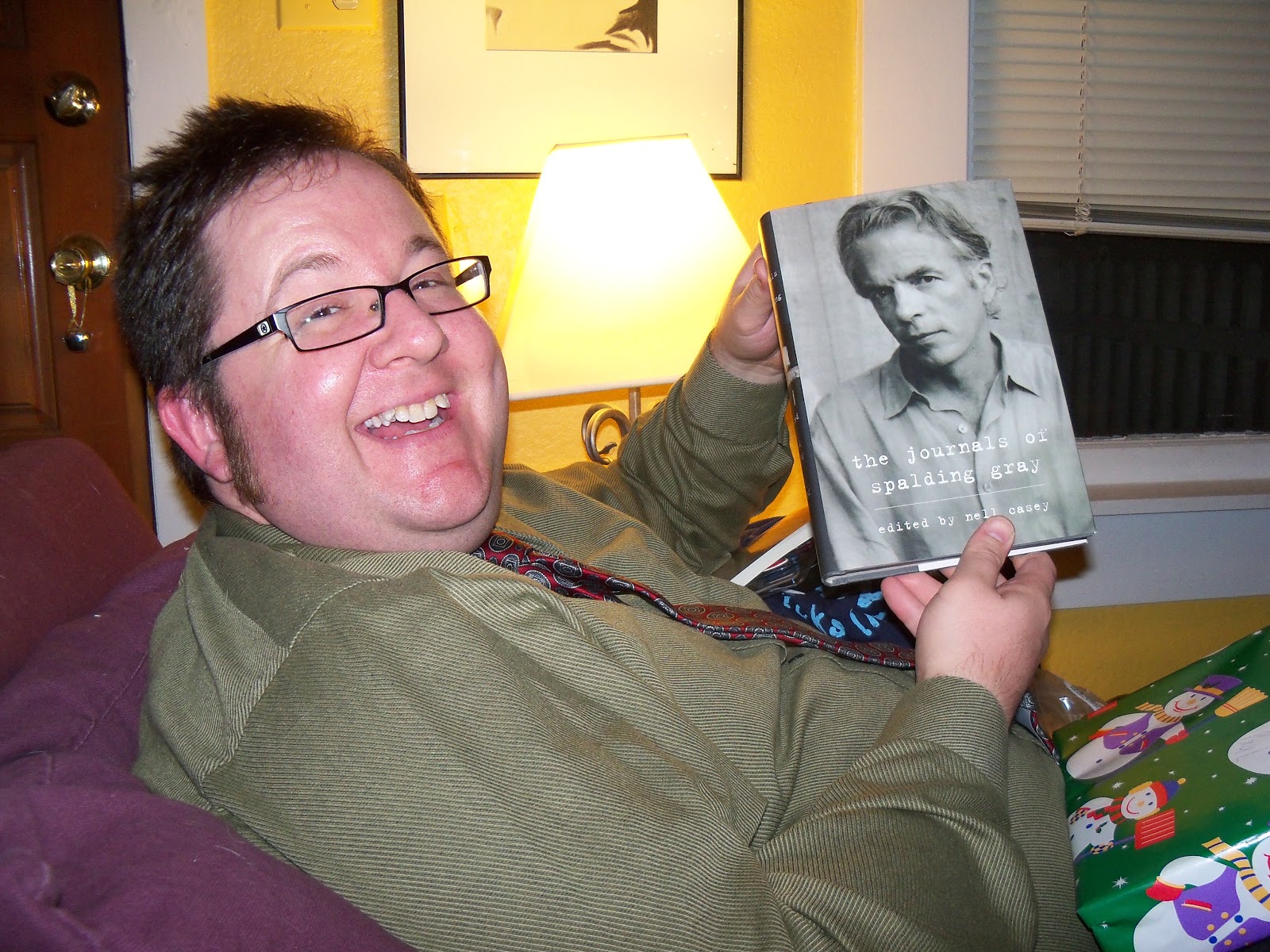
Another book I am beside myself with joy to own and read is the Journals of Spalding Gray.
We got garden gnomes climbing a rope for my mother.
Edgar Allan Poe tea.
My aunt sent me a sketchbook, which was a wonderful choice. Ever since that Lagerfeld film I have been thinking of getting back into sketching, specifically design ideas that will never see realization.
I think these are in reverse chronological order, but we had a lovely dinner.
Gina brought us wine from Georgia. It has Joseph Stalin on it.
Laurie got me a cultural history of ballet, which I immediately started reading.
Schubert got a splendid little hat.
Gina brought me a book of Georgian poetry.
Gina brought Laurie art from Georgia.
Laurie bought me a messenger bag. For the sake of brevity, Laurie bought me some wonderful new clothes. I bought her a few books. There were other things. But the big news is Tony and Karina who got us a grandchild for Christmas. Ezekiel Anthony was born on the 23rd.
That was our Christmas in brief. It was undoubtedly on the short list of my favorites in my life so far.
Monday, December 26, 2011
Time Capsule
Dear Ezekiel,
On the day you were born, your great-grandparents were up visiting for Christmas. They gave me the laptop on which I write this for that very Christmas. They took your Oma and I out to dinner and I had a martini that tasted like toasted marshmallows. Aunt Gina was there too. She had just returned from the Republic of Georgia a few days before. She had been teaching English over there.
They let me leave work early on account of your being born and, as I'm sure you're used to by the time you read this, the maddening beat of the impending holiday, like a heart under the floorboards.
It was a slow news day. Newt Gingrich failing to file the signatures required for him to get into the Virginia primary was one of the top news stories. Newt Gingrich was a man who ran for president in 2012. Believing in a benevolent God, I assume you will never have heard of him. The Sherlock Holmes film with Stephen Fry as Mycroft Holmes was the top grossing film. If I live long enough for you to get to know me, I'm sure you'll know exactly who that was. Also perhaps worth mentioning, there were people who said that the world would end just shy of a year after you were born due to some blip in an ancient civilization's calendar. Early in the year you were born, a charlatan predicted a date on which the world would end and then, when it didn't, picked another date later in the year. Some people were fooled both times. I hope you'll take this as a lesson about secret knowledge, conspiracy theories, and people trying to sell themselves as special with the sexy temptation of being a present "insider" (and future fool.)
Earlier we had gone to visit you at Enloe. I held you when you were only about an hour and a half out of your mother. You didn't open your eyes and we didn't hear you cry for two more days. You were a very peaceful baby. May you remain so.
I intend to teach you Shakespeare and Shaw, Beethoven and Mozart, Socrates and Schopenhauer. I intend to buy a high-end telescope so that we can look into the heavens. I hope that we can travel and I hope that you will see the world. I especially hope to take you to the theater, the opera, and the ballet when you are old enough to shut up and not wiggle around in your seat the whole time. This past Sunday, which was Christmas, I was talking to my pastor after the service and he talked about how it's difficult to produce a Christmas sermon. One must present the Advent story, a story which one can assume that almost the entirety of the congregants know. I remembered when I performed my first (hopefully not last) one-man show a few years ago. So many people expressed that they wished that I would have recorded the event on video. I would always reply that it wasn't staged for video, but more importantly, it wasn't for the ages. It was, like so much of life, a moment in time that exists within the space-time frame, but, as far as we are concerned, has passed out of our reach through the progression of time.
That's part of why I love photography so much. The picture above is of the moment when I first held you. As you can see, people were rushing around us. The room was full of activity and vistors. But the camera captured the light of that moment and now you can see it, your hypothetical children can see it, and the alien archeologists of the 45th century can see it. There is a beauty in and of itself to the preservation of beauty, but there is also a beauty to the fleeting in its ungraspability. There is wonder in both and, indeed, in all things.
I hope you get to experience a multitude, a veritable glut of ideas and world-views. You get to choose the ones you love, the ones you adopt, the ones you improve upon, the ones you reject outright. You get to make ones of your own.
I don't know what the experience of life will be like for you or what the combined forces of nature and nurture will produce in you. I hope you will be happy. I hope you will come to understand the necessity of kindness, compassion, and peacefulness. I hope that you will learn that you need not doff your hat to any man, as we are all created equal. I hope you will share and love truth. I hope you will not be tempted to the overwhelming trend toward the trite and bourgeois emotional life of our day, which presents such asininities as boredom and self-righteousness as birthrights. They aren't. They are both born from the pit of Hell.
Anyway, welcome. I hope you have fun.
Your loving Papageno,
Paul Mathers
Tuesday, December 13, 2011
The Effects of Karl Lagerfeld on the Soul of Paul Mathers
I almost never write about movies we've watched. I do tend toward movies that inspire or provoke or have great ideas. While I do try to use the blog to interact with the higher aspirations of humankind, it's really just that I don't want to have the sort of blog where I talk about movies. I am breaking that self-imposed rule here for the sake of something Laurie and I watched which has been like a splinter under my fingernail. The film was Lagerfeld Confidential.
I try not to place too many of my eggs in the "heroes" basket and, aside from Stephen Fry, I am hard pressed to think of many living people who would qualify for that distinction in my own mind. However, I do have a great deal of people of interest in my life and, as people who know me well know well, Karl Lagerfeld is one of those people. For those of you who don't know, Mr. Lagerfeld is the Creative Director of Chanel, Fendi, and his own lines. He is also an extraordinarily accomplished photographer. He is a highly intelligent man, a bit of a Classicist himself with a fluency in Greek and Latin (and German and French and English and Italian.) He has one of the famous and coveted personal libraries in the world.
One thing I do not wish to do here is to pass judgment on Mr. Lagerfeld's life based on a 90 minute movie nor, more to the point, on my emotional reactions to that 90 minute movie. I felt a magnificent loneliness in the film, and I felt as if it were by the design of the documentary filmmaker. It seemed to me that the interview segments interspersed with the action of the film were full of questions that attempted to lead Lagerfeld to comment on his loneliness. There were questions about his mother, his love life, his intense work ethic, the frivolity of the world in which he works, the distance of friends, his ability to break long-term ties, all of which Lagerfeld explains away as to why he is not lonely. However, the evidence seems to mount to us, the viewers, as the many variations on the question are asked.
Along with that, the footage that was chosen from a long period of following the man often seems to back up that thesis. In one scene Lagerfeld is shown affectionately patting a colleague's hand. The lady comments on how it hurts when he does that because of all of the rings he wears. In another scene Lagerfeld sits in a villa courtyard surrounded by bags of books that he has purchased on a trip. In the background there are people milling about. Lagerfeld, one of the most iconic figures on the planet, is framed in such a way so as to amplify that he is sitting alone with his bags of stuff. On the streets he is stopped on a walk every few steps by someone wanting to have their photograph taken with him. He graciously obliges and, after the photos, the people walk away looking at the picture on their cameras. Getting a collection together, he is filmed walking up the famous Chanel mirrored staircase alone, stepping on sketches to do so.
At the end of the film, I found I felt like I knew less about Karl Lagerfeld than when I started. I caught myself wondering what Christmas is like for Mr. Lagerfeld or what it's like when Mr. Lagerfeld has a head cold. But there is also an appropriate armor to the whole experience. I am not to know those things, nor should I really. I almost felt as if the point of the movie was to show me that I should enjoy the work of the artists I enjoy and leave off trying to know anything about people I will never get to know. I think there is a good lesson there. We know next to nothing about Shakespeare's life, yet his work is universal and we can all still enjoy it 500 years later. Why shouldn't that be true for contemporaries as well? Why should we always be so concerned over who made a thing?
Lagerfeld seems to have sort of an Epicurean Stoicism of a practical philosophy, with a dash of Existentialism. He is not a man of faith, nor a man to whom faith seems to hold any attraction. He speaks of his mother's constant frivolity along with Germanic arms' length, and I certainly saw the apple on the ground right next to that tree. His is a life of constant work and he has built an empire in which he is able to 1) create the art that he wants to create, 2) surround himself with the beauty he wants to surround himself with, and 3) allow himself as much time alone as he wants. He is constantly moving forward, chasing the dragon as it were, never looking back. There's almost a bit of the heavenly in that sort of forgetting, the sort of thing, I know from experience, I was looking for, and to some extent finding, in alcoholism. That sounds way more condemning than I mean it to sound. What I mean to say is that I feel like I totally understand the impulse to constantly look forward and forget what lays behind. Of course, his version is a lot more healthy as it is an active version: a constantly mutating vision. But I was rattled by how much I understood this part of it viscerally.
All of which I find compelling, and all of which mirrors some of my own more earthly desires. I think if I were not a man of faith, Mr. Lagerfeld's view would be about as good as it gets. Still, after the movie, Laurie was, I think, even more disturbed than I was by it. In talking with her about it, I mentioned that there is a figure in Christian theology who is known to have Beauty removed from Love. Again, I do not wish to pass any sort of judgment here. Aside from the trappings of the persona, I don't feel there's anything particularly Mephistophelean about Mr. Lagerfeld, at least no more so than any other figure in the fashion industry. He is, after all, just another human trying to live his life. I sincerely hope that he is very happy as he has brought a lot of beauty into this world. I admire his work tremendously. However, I find myself a little unnerved by what this suggests to me about beauty in and of itself. I am inclined toward the pat little axiom of Keats about how Truth is beauty and beauty truth. I am inclined, like Wilde, to advocate a sort of inherent goodness in beauty, a reflection of the divine delight in the aesthetically pleasing. But after watching this film, it makes me question a bit about what is a "good life." I think the answer is more of a question of balance. Even in the Platonic understanding, beauty is not one of the cardinal virtues. I do think that there is a goodness to beauty, however I feel that it is entirely limited to beauty. We foolish creatures always want to extend that value to other aspects, but it just is not so. Take it from a homely man.
Mr. Lagerfeld, especially in response to the sections regarding his mother, eschews analysis. In that sense we are almost the polar opposite. I believe in a life well examined. I am a passionate enthusiast of Freud and Jung. I also know that we all are beings created through a mixture of circumstance and will. We show what we choose to show and are fully capable of hiding what we choose to hide. It doesn't make things disappear to hide them. He says near the end of the film "I don't want to have reality in anyone's life because I don't want it in mine." I understand this completely and there is a level in which I can almost covet that kind of thinking. Reality is unspeakably awful, but I can't be a ghost. It's not enough for me.
I try not to place too many of my eggs in the "heroes" basket and, aside from Stephen Fry, I am hard pressed to think of many living people who would qualify for that distinction in my own mind. However, I do have a great deal of people of interest in my life and, as people who know me well know well, Karl Lagerfeld is one of those people. For those of you who don't know, Mr. Lagerfeld is the Creative Director of Chanel, Fendi, and his own lines. He is also an extraordinarily accomplished photographer. He is a highly intelligent man, a bit of a Classicist himself with a fluency in Greek and Latin (and German and French and English and Italian.) He has one of the famous and coveted personal libraries in the world.
One thing I do not wish to do here is to pass judgment on Mr. Lagerfeld's life based on a 90 minute movie nor, more to the point, on my emotional reactions to that 90 minute movie. I felt a magnificent loneliness in the film, and I felt as if it were by the design of the documentary filmmaker. It seemed to me that the interview segments interspersed with the action of the film were full of questions that attempted to lead Lagerfeld to comment on his loneliness. There were questions about his mother, his love life, his intense work ethic, the frivolity of the world in which he works, the distance of friends, his ability to break long-term ties, all of which Lagerfeld explains away as to why he is not lonely. However, the evidence seems to mount to us, the viewers, as the many variations on the question are asked.
Along with that, the footage that was chosen from a long period of following the man often seems to back up that thesis. In one scene Lagerfeld is shown affectionately patting a colleague's hand. The lady comments on how it hurts when he does that because of all of the rings he wears. In another scene Lagerfeld sits in a villa courtyard surrounded by bags of books that he has purchased on a trip. In the background there are people milling about. Lagerfeld, one of the most iconic figures on the planet, is framed in such a way so as to amplify that he is sitting alone with his bags of stuff. On the streets he is stopped on a walk every few steps by someone wanting to have their photograph taken with him. He graciously obliges and, after the photos, the people walk away looking at the picture on their cameras. Getting a collection together, he is filmed walking up the famous Chanel mirrored staircase alone, stepping on sketches to do so.
At the end of the film, I found I felt like I knew less about Karl Lagerfeld than when I started. I caught myself wondering what Christmas is like for Mr. Lagerfeld or what it's like when Mr. Lagerfeld has a head cold. But there is also an appropriate armor to the whole experience. I am not to know those things, nor should I really. I almost felt as if the point of the movie was to show me that I should enjoy the work of the artists I enjoy and leave off trying to know anything about people I will never get to know. I think there is a good lesson there. We know next to nothing about Shakespeare's life, yet his work is universal and we can all still enjoy it 500 years later. Why shouldn't that be true for contemporaries as well? Why should we always be so concerned over who made a thing?
Lagerfeld seems to have sort of an Epicurean Stoicism of a practical philosophy, with a dash of Existentialism. He is not a man of faith, nor a man to whom faith seems to hold any attraction. He speaks of his mother's constant frivolity along with Germanic arms' length, and I certainly saw the apple on the ground right next to that tree. His is a life of constant work and he has built an empire in which he is able to 1) create the art that he wants to create, 2) surround himself with the beauty he wants to surround himself with, and 3) allow himself as much time alone as he wants. He is constantly moving forward, chasing the dragon as it were, never looking back. There's almost a bit of the heavenly in that sort of forgetting, the sort of thing, I know from experience, I was looking for, and to some extent finding, in alcoholism. That sounds way more condemning than I mean it to sound. What I mean to say is that I feel like I totally understand the impulse to constantly look forward and forget what lays behind. Of course, his version is a lot more healthy as it is an active version: a constantly mutating vision. But I was rattled by how much I understood this part of it viscerally.
All of which I find compelling, and all of which mirrors some of my own more earthly desires. I think if I were not a man of faith, Mr. Lagerfeld's view would be about as good as it gets. Still, after the movie, Laurie was, I think, even more disturbed than I was by it. In talking with her about it, I mentioned that there is a figure in Christian theology who is known to have Beauty removed from Love. Again, I do not wish to pass any sort of judgment here. Aside from the trappings of the persona, I don't feel there's anything particularly Mephistophelean about Mr. Lagerfeld, at least no more so than any other figure in the fashion industry. He is, after all, just another human trying to live his life. I sincerely hope that he is very happy as he has brought a lot of beauty into this world. I admire his work tremendously. However, I find myself a little unnerved by what this suggests to me about beauty in and of itself. I am inclined toward the pat little axiom of Keats about how Truth is beauty and beauty truth. I am inclined, like Wilde, to advocate a sort of inherent goodness in beauty, a reflection of the divine delight in the aesthetically pleasing. But after watching this film, it makes me question a bit about what is a "good life." I think the answer is more of a question of balance. Even in the Platonic understanding, beauty is not one of the cardinal virtues. I do think that there is a goodness to beauty, however I feel that it is entirely limited to beauty. We foolish creatures always want to extend that value to other aspects, but it just is not so. Take it from a homely man.
Mr. Lagerfeld, especially in response to the sections regarding his mother, eschews analysis. In that sense we are almost the polar opposite. I believe in a life well examined. I am a passionate enthusiast of Freud and Jung. I also know that we all are beings created through a mixture of circumstance and will. We show what we choose to show and are fully capable of hiding what we choose to hide. It doesn't make things disappear to hide them. He says near the end of the film "I don't want to have reality in anyone's life because I don't want it in mine." I understand this completely and there is a level in which I can almost covet that kind of thinking. Reality is unspeakably awful, but I can't be a ghost. It's not enough for me.
Sunday, December 11, 2011
A Few Notes on the Translation
![]() |
| My preferred sort of libation bearers |
I thought I might follow up on my post about Agamemnon by providing some examples of what I was talking about in regards to translations. As a quick aside, I would also like to encourage everyone, once again, to write letters to people that you admire and to do it immediately. In preparing for this post, I learned that Robert Fagles died only 4 years ago. I should liked to have written to him and thanked him for his work.
What I'm going to do is simply to show you three different translations of the first line of The Choephori (or The Libation Bearers.)
The first is the version used by Dr. Eliot in the Harvard Classics series. Do bear in mind that Dr. Eliot was assembling his series in 1910 and that we currently and constantly reap the benefits of an accelerated culture to the point of taking it for granted. I retain my charter membership in the Dr. Eliot Fan Club. The translation is by E.D.A. Morshead (Edmond Doidge Anderson Morshead in case you were wondering.) As a cute aside, Mr. Morshead was marked by his students to have a distinctly peculiar and eccentric upper-class accent which they called "Mushri" as if it were a different language. His students compiled a "Mushri to English" dictionary, nicknamed him "Mush", and, predictably, his classroom was called "The Mushroom." I think I would have liked Mr. Morshead. He was a fellow Classicist of a Liberal mind. He championed scientific advances as a Classicist, believing that reaching toward the highest aspirations of humankind is what the classics point to and what ought to be going on at any given time in a great society. He also made academic translations of classical literature which I find next to unreadable. Here is his opening lines of The Libation Bearers:
"Lord of the shades and patron of the realm that erst my father swayed, list now my prayer Hermes, and save me with thine aiding arm, Me who from banishment returning stand on this my country; lo, my foot is set on this grave-mound, and herald-like, as thou, once and again bid my father hear."
Doesn't exactly trip off the tongue and I have a difficult time imagining how to perform sentences like that in a way that would engage an audience.
Philip Vellacott translated the version I own, which is an older Penguin edition. Vellacott was of my great-grandparent's generation. He was a conscientious objecter to the Second World War, being a member of the Peace Pledge Union. The Peace Pledge was a document that members of that union signed which stated "I renounce war, and am therefore determined not to support any kind of war. I am also determined to work for the removal of all causes of war." I might get in trouble for saying this because it is largely considered the "just war," but I do have some admiration for the special courage it takes to make that kind of a stand. Although as another aside, I'm a little shaky on my enlistment criteria history, but he was around my age at the beginning of that war and I do have some doubts as to how much demand he would have been in anyway. I have a soft spot for conscientious objectors due to my Quakerism and due to my father's heroic (to me at least) conscientious objection to what I believe was the second most "unjust war" in my nation's history to date.
I will also include some of Professor Vellacott's obituary by Richard Luckett from The Independent in 1997: "In person he was slim, erect, quizzical and tenacious. He was a resolute walker, and a pianist of professional competence who knew the entire Art of Fugue by heart, if at a rather steady pace. He had Shakespeare virtually word for word. His sister Elisabeth is a distinguished artist, several of whose finest works he possessed."
I think I would have liked Mr. Vellacott as well. Here's a work by Elisabeth Vellacott called Evening Walk:
Philip Vellacott claimed that he got in a bit of trouble with the Classical establishment over positing that these works in particular were filled with political motivation. This seems to smack a bit of falsehood as Classical literature in his day was almost entirely composed of such theories and I feel that his translation may suffer a bit from putting forth theories, rather than to attempt to recreate the work itself. Also, he wrote a translation that was used widely for decades which is precisely the sort of thing that allows the Classical establishment to continue to exist.
Granted, that doesn't stop people within the Classical establishment from complaining about it. I am continually amazed by how low ratings almost all operas have on Netflix. Not because they are bad by any means, but rather because the opera fans are so devising, persnickety, and catty that not their favorite soprano or too many close ups means the opera gets a lower rating than Troll 2. This is really where I feel that Classicists cut their own throats in front of the rest of the world.
Philip Vellacott's version is an improvement over the Morshead to be sure, but still a bit clunky and wordy I thought. But infinitely more readable. Here, again, the opening line:
"Hermes, Guide of the dead men's souls below the earth, Son of Zeus the Deliverer, fill your father's office: Be my deliverer. Receive my prayer; fight in my cause. An exile newly returned to this my land, my home, I seek my native right. Over this mound, his tomb, before my deed is in hand, I call on my dead father to hear, to sanction."
I hope that my examples will make this needless to say, but I would read anything Robert Fagles translated. Fagles, as I mentioned before, is the most modern of the three and I feel that there is a lot of be said for constantly renewing the most accurate and most contemporary translation of a classical piece of literature, especially as our language continues to evolve so rapidly.
I recognized the name when I went to the library yesterday as the same translator who afforded a solution to a similar problem I had when reading The Odyssey a year or so ago. Fagles was a Princeton professor. His father died when he was 14 and it only just struck me that the very text I've pulled for this post is Orestes at the grave of his father.
He translated "The Big Three" of Classical Literature, being The Odyssey, The Iliad, and The Aeneid. In a New York Times interview concerning the latter he said, "It says that if you depart from the civilized, then you become a murderer... The poem can be read as an exhortation for us to behave ourselves, which is a horse of relevance that ought to be ridden.”
I was immediately struck by the clarity of his translation and instantly put aside any thought of reading any other version when I read his opening line:
"Hermes, lord of the dead, look down and guard the fathers' power. Be my saviour, I beg you, be my comrade now. I have come home to my own soil, an exile home at last, here at the mounded grave I call my father, Hear me, -I am crying out to you..."
I would also add that, of the three, I feel like this is the one that would play best on stage. The language provides opportunity to explore and convey the emotion involved and communicate said emotion to the audience clearly.
And, at the end of it, I feel like if one let's the stories speak for themselves, one can feel the rustle of the ages behind it. One can identify with the very human stories. But, like so much of life, the ground becomes richer the deeper you dig.
Friday, December 9, 2011
“I will honor Christmas in my heart, and try to keep it all year.”
| Don't blink. |
Last year, I embarked on a project sometime in very early December to post a "Christmas song that doesn't suck" on Facebook every day until Christmas. I remember that my self-imposed task became very difficult very quickly, but, in spite of remembering that difficulty, I had a few moments of toying with the idea of doing it again this year (I also toyed with the idea of posting Christmas songs that suck tremendously.) I came back across one of my favorite contemporary Christmas songs by Tim Minchin. I think it is one of the most beautiful Christmas songs I know. High on the short list anyway.
As most of you probably know, I work in elder care. I believe that, largely based on the fact of our collective medical condition that I've just mentioned coupled with our staggering procreative capacity, elder care is our immediate future. There is a coming tidal wave of need in that department, considering the mess of a health care and insurance industry we have in America and the Have Generations giving way to the Have Not Generations. What's past is prologue. There is a massive coming need.
One phenomenon I've observed in my work is that of rampant despair. I often find myself called upon by someone to explain to them why they are still alive and I'm afraid I don't have an answer to that question. I usually explain that I too am not exactly sure why I'm still alive a great deal of the time and given that the Almighty has fixed His canon 'gainst self-slaughter, ours is simply to persevere in the faith that there is a reason and enjoy what's left of the gift we've been given. Usually followed by suggesting an activity. There is nothing like an activity to dispel despair. I also mean to suggest that the qualitatively best application of that gift can be found in religion. A mix of the Epicurean and Kierkegaardian Existentialism to be sure, but that is the man that I seem to have become. That is where I find myself coming into this, my 34th Christmas. In other words, I am faced with the bald truth and am left with nothing else but to carry on.
The song is, of course, a highly personal one. Not everyone's family is a place where one feels safe. When I re-listened to this song this afternoon in what was probably at least in my second dozen times of hearing it, I was struck by the part where he speaks to his future daughter at ages 21 or 31. What specifically struck me was that those are around the ages in which it is reasonable to assume that one's mother, father, and possibly even grandparents will still be alive. I feel that all the more keenly as moment by moment I draw closer to the following decade.
Mr. Minchin is an atheist. I am not, although I talk about God's silence and absurdity and the void (and being freaked out by churches) with all of the faith of an atheist. As most of you know, I do, however, go in for ancient wisdom and feel that some tenacious ideas have survived out of worthiness while others not so much. One must needs evaluate them for one's self.
However, I am not responding to an atheist with the customary snide Christian attitude of having the market cornered on truth. I almost became an atheist a few years ago.
There is an Arthurian legend about the Fisher King which, like a lot of Arthurian legends, has a wide range of versions. One version is that there is a king who is wounded on the thighs or groin with a wound which will not heal. The king's land becomes a barren wasteland (symbolic of the wound and, I would add, where T.S. Eliot got the name for his masterpiece) and he is forced to fish for food. Parzival or Percival happens by on his quest for the Holy Grail. Percival fails to ask the Fisher King about his wound at the correct moment. That act of Christian charity, compassion, and concern would have healed the Fisher King of that very wound. Stories vary over the resolution (if any.) I was thinking about this story the other day and toying with the idea of a reinterpretation in which the wound came from Christianity, but was healed by Christ.
I was ardently religious in my late 20s and early 30s, but a little over two years ago I was first introduced to a contemporary movement in Christianity which is one of the most evil things I've ever heard of. I am fully convinced that that side of Christianity is destined to be as regrettable and as black of an eye to the face of Christ as the Crusades or the Inquisition or the witch hunts. I've written about it before and so won't rehash that part of it. I really needed to see Christianity oppose this evil, but instead found that a great deal of the Christian world either condoned and defended it, or simply ignored it.
At around the same time, my best friend died. It was sudden and he was not ill.
I reached a point, within the past year or so, where I asked myself if I could not believe. I found that I could not not believe. I was one of Pascal's "doomed to be a believer." Once I came to that realization, it was a relief, but a relief like how it was a relief to Kafka to get tuberculosis. I passed the point of no return, but I am still a product of the experiences which brought me past that point. The house had blown down, but I found that the foundation was still intact.
I also came to the realization that there are two ways to handle pain in this life. One is to arrange one's life in such a way so as to avoid that pain in the future at all costs. This is a decision born from a sort of informed fear. I'm not a big fan of fear. The other is to persevere in the face of future pain, to take arms against a sea of troubles and by opposing end them.
So, I have the religious side of Christmas to deal with too, but I am entirely sympatico with the sentiment of choosing to just enjoy it. I feel like so much of our culture is so jaded and ironic that one is shamed into not enjoying things like Christmas.
Which not to say that I feel that there is any war about Christmas in our culture aside from that between the tasteful and the gauche. My unsolicited advice to the alarm junkies, who are hoisting their own petard in perpetuating the nonsensical notion that there is, in fact, some sort of culture war involving Christmas, would be simply this: Then work to make Christmas something worth preserving in our culture. Your outrage ought not go to someone bidding a sincere "Happy Holidays." You should be outraged over stores pulling people away from the very hallowed day of Thanksgiving now with the temptation of bargains. I mean, is putting up a tree or a tawdry plastic light-up Nativity scene on a lawn so damned important that you'll let it stand in the way of fellowship and brotherhood? Over a day in remembrance of He who taught that loving your neighbor and God was the sum of the Law and told stories about loving Samaritans?!!?
Just because an idea is tenacious doesn't mean that it's worthy. A healthy society preserves that which is worth preserving. I certainly agree with the Socratic ideal that a good life is a virtuous life and I believe that can be applied to everything we participate in. In fact, I think it better had.
There is another point I would like to make about the Season as I wrap up. Laurie and I were reading Charles Hummel's Tyranny of the Urgent in which Mr. Hummel is struck to the core by a piece of ancient wisdom that a factory manager tells him. He said, "Your greatest danger is letting the urgent things crowd out the important."
I can assure you that, unless you're exceedingly creepy or haunted by a history riddled with "priors", you can walk into any assisted living facility, walk up to the activities director, and offer your services. It could be as little as a half an hour a week. You can sing, you can make crafts, you can write, you can have a book club, you can play games, you could even just read aloud to the residents. They would be thrilled and you would be a valued rarity. Why would I say that at this point? Well, as James wrote, "Religion that is pure and undefiled before God, the Father, is this: to visit orphans and widows in their affliction, and to keep oneself unstained from the world." That's how you honor Christmas.
This Christmas I hope that you get to be surrounded by the people you love and who love you. I hope you have people who make you feel safe and I hope you can be surrounded by them. I wish you joyful memories that you can carry with you for the rest of your life. I pray that you can disregard all of the white noise.
Thursday, December 8, 2011
Agamemnon
I would like to start out by talking about the art of translation. The translation that I read was awful. What I tend to look for in a translation is 1) readability with minimal sacrificing of 2) the intended meaning of the original writers. Ideally, 3) also beautiful. That is why I am more likely to read, say, Robert Pinksy's translation of Dante's Inferno than one by an academic who is focused on accuracy. I look for the Apple Computers of translations. Elegant, user-friendly, without limiting one's options intellectually.
It might not surprise you to know that I have had friends so pedantic as to be anti-translated material. Their argument is that one is not reading, say, Aeschylus, but rather, in my case, one is reading the work of E.D.A. Morshead. I understand the argument, but that does not change the fact that I want to read Aeschylus. Also, barring one's self from reading anything translated from another language is barring one's self from an awful lot of great literature, as well as penning one in with the danger of ethnocentrism. But it is true that unless you're reading Oscar Wilde, chances are you are not going to read the actual literal words of the actual literal original author.
I tend toward thinking of translations as grey areas. Attempts at a completely literal, word for word translation from one language into English are sort of bi-path into communicating with someone to whom English is their second language (albeit, their mastery of the Queen's English is helplessly in the hands of a second party.) If we're talking about something like, say, The Message, which is a contemporary paraphrase of the Bible, I am willing to say that one is not really reading the Bible. But that is purely my opinion and being aware of the grey area of translation, it is hardly a hill I would choose to die on. In other words, I wouldn't read it, but I also wouldn't be so pompous and divisive as to tell someone who does that they are not really reading scripture. To make a long point short, I think it's important to know the issues and limitations inherent in reading translated works, and I think it is important to read them anyway. If anything, I think in a lot of ways it broadens the options presented to the reader of a work rather than limiting them.
All of which was unfortunate in this case. As with so many great works of antiquity, it is a rip-roaring good soap opera with buckets of blood. Lamentably, I spent a great deal of my time trying to figure out what they were talking about. I do not wish to brag, but I am an exceedingly intelligent man. It shouldn't have to be like that for me! There are other translations out there available to me and I don't feel compelled to limit myself to Dr. Eliot's choice in this instance (even though I am limiting myself to Dr. Eliot's overall choice for the next few years.)
So, here are a few thoughts, without writing any papers for the seemingly endless line of students who plagiarize my blog:
- We see in Clytemnestra's tempting of Agamemnon to walk on the red carpet a Hero With a Thousand Faces moment with echoes of The Fall in Genesis, right down to the similar results.
- Agamemnon is an enviable part. Much like Tartuffe, I kept imagining the actor having both the glory of being billed as the title character and a great deal of time to read backstage. I experienced that firsthand when I played in Gilbert and Sullivan's The Mikado as the title character. You show up mooing about with Cassandra, you schlepp up the red carpet, and half an hour later you bellow "O! I am slain" from out your dressing room door. You'll be in the pub by 10.
- Sure, Aegisthus is squatting in Agamemnon's house and cuckolding him, but the apple didn't fall too far from the tree. Just ask Cassandra.
- Speaking of Cassandra, we have a divine invasion in the play. I can't decide if the power to see future events but not have anyone believe you until it's too late is a horrible thing or the best thing ever. I know what the play wants me to believe. And it doesn't end so well for her.
- Aside from failing the Bechdel Test, I have a difficult time with discerning Aeschylus' view of women. The two in this show are strong women, but not exactly positive role models. Actually, upon reflection, it is difficult for me to discern a protagonist in this piece aside from, arguably, The Chorus!
- The Chorus has a more solid Fourth Wall in this show than in some other Greek works. In fact, they are heavily emotionally invested in the action, to the point where they nearly take it upon themselves to effect justice.
I did enjoy the experience of reading this play, but, again, I am fairly certain I am going to seek out a more readable translation for the balance of The Oresteia.
It might not surprise you to know that I have had friends so pedantic as to be anti-translated material. Their argument is that one is not reading, say, Aeschylus, but rather, in my case, one is reading the work of E.D.A. Morshead. I understand the argument, but that does not change the fact that I want to read Aeschylus. Also, barring one's self from reading anything translated from another language is barring one's self from an awful lot of great literature, as well as penning one in with the danger of ethnocentrism. But it is true that unless you're reading Oscar Wilde, chances are you are not going to read the actual literal words of the actual literal original author.
I tend toward thinking of translations as grey areas. Attempts at a completely literal, word for word translation from one language into English are sort of bi-path into communicating with someone to whom English is their second language (albeit, their mastery of the Queen's English is helplessly in the hands of a second party.) If we're talking about something like, say, The Message, which is a contemporary paraphrase of the Bible, I am willing to say that one is not really reading the Bible. But that is purely my opinion and being aware of the grey area of translation, it is hardly a hill I would choose to die on. In other words, I wouldn't read it, but I also wouldn't be so pompous and divisive as to tell someone who does that they are not really reading scripture. To make a long point short, I think it's important to know the issues and limitations inherent in reading translated works, and I think it is important to read them anyway. If anything, I think in a lot of ways it broadens the options presented to the reader of a work rather than limiting them.
All of which was unfortunate in this case. As with so many great works of antiquity, it is a rip-roaring good soap opera with buckets of blood. Lamentably, I spent a great deal of my time trying to figure out what they were talking about. I do not wish to brag, but I am an exceedingly intelligent man. It shouldn't have to be like that for me! There are other translations out there available to me and I don't feel compelled to limit myself to Dr. Eliot's choice in this instance (even though I am limiting myself to Dr. Eliot's overall choice for the next few years.)
So, here are a few thoughts, without writing any papers for the seemingly endless line of students who plagiarize my blog:
- We see in Clytemnestra's tempting of Agamemnon to walk on the red carpet a Hero With a Thousand Faces moment with echoes of The Fall in Genesis, right down to the similar results.
- Agamemnon is an enviable part. Much like Tartuffe, I kept imagining the actor having both the glory of being billed as the title character and a great deal of time to read backstage. I experienced that firsthand when I played in Gilbert and Sullivan's The Mikado as the title character. You show up mooing about with Cassandra, you schlepp up the red carpet, and half an hour later you bellow "O! I am slain" from out your dressing room door. You'll be in the pub by 10.
- Sure, Aegisthus is squatting in Agamemnon's house and cuckolding him, but the apple didn't fall too far from the tree. Just ask Cassandra.
- Speaking of Cassandra, we have a divine invasion in the play. I can't decide if the power to see future events but not have anyone believe you until it's too late is a horrible thing or the best thing ever. I know what the play wants me to believe. And it doesn't end so well for her.
- Aside from failing the Bechdel Test, I have a difficult time with discerning Aeschylus' view of women. The two in this show are strong women, but not exactly positive role models. Actually, upon reflection, it is difficult for me to discern a protagonist in this piece aside from, arguably, The Chorus!
- The Chorus has a more solid Fourth Wall in this show than in some other Greek works. In fact, they are heavily emotionally invested in the action, to the point where they nearly take it upon themselves to effect justice.
I did enjoy the experience of reading this play, but, again, I am fairly certain I am going to seek out a more readable translation for the balance of The Oresteia.
Subscribe to:
Posts (Atom)